MELISSINOS “A MINOR LEGEND IN THE CITY OF LEGENDS”

By Jason Schoonover  / CANADA HERALD TRIBUNE  / 1978
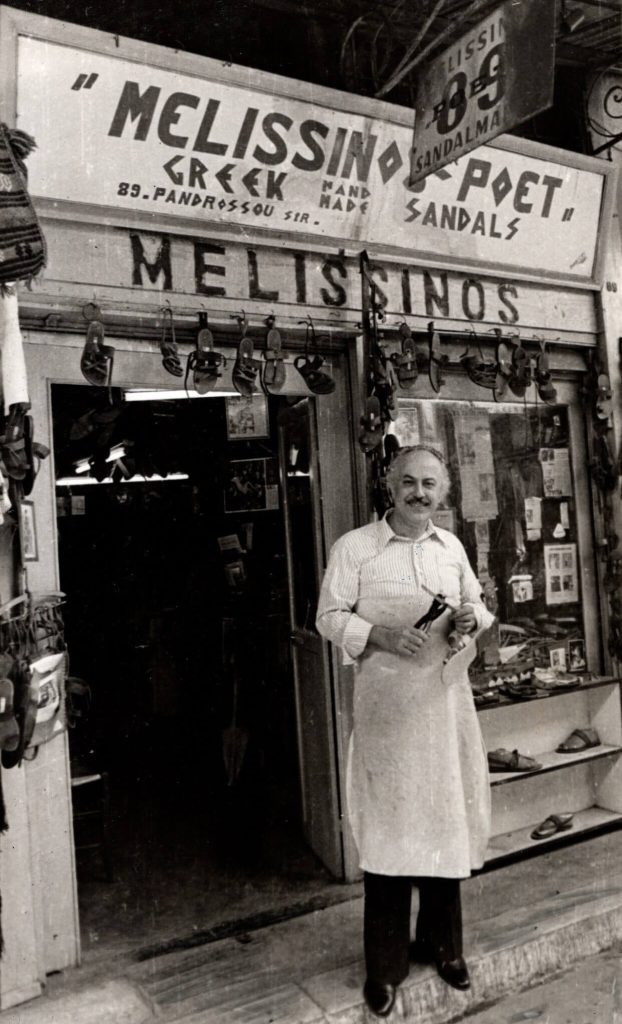
Stavros Melissinos in front of his historic Greek sandal workshop in Athens, known as “The Poet Sandal Maker.” Photograph courtesy of Jason Schoonover.

ATHENS– It’s not often that an individual becomes a tourist attraction, but this is the case with the poet sandal maker of Athens’ flee market, Stavros Melissinos, to describe him as modest legend would be closer to the truth.

An internationally acclaimed poet in his own right, he is also the sandal maker to the likes of Sophia Loren, who has been wearing his products since she filmed “Boy on a Dolphin” in local waters, so long ago nobody wants to remember, the Beatles, Rudolph Nureyev, Margo Fontain, Jacqueline Onassis, Anthony (Zorba, the Greek Tycoon) Queen, George Peppard, Ursula Andress and the late Joseph Cotton and Garry Cooper. With a clientele like that, he must have been doing something right.

Melissinos’ tiny, unpretentious shop lies in the shadow of the Acropolis, adjacent to Monastiraki Square. There you can see the colorful, confused congestion of stalls, carts and shops making up the large flee market, where such touristoria as pounded brass pots and pans, imitation statues of Athena and postcards are bartered for and sold. In an area where the drachma isn’t what it used to be, and where it’s often best to beware of Greeks bearing gifts for sale, Melissinos stands out as a soft sell merchant and craftsman offering for sale at a reasonable price a quality product he produced with his own honest labor.

He is situated at 89 Pandrossou, that narrow street, lined with narrower shops, that is largely depended on the vacationing foreigner attracted to the Greek life style. There, among the clutter and the smell of leather, Greece’s best-known poet, playwright and literary translator mellowly plies his trade.

The subject of all the attention is a balding middle-aged man softening a bit around the middle, but with the happy, uncluttered eyes of a child and a face as soft as the calve’s leather he tools with deft sureness.

Since he begun writing poetry in 1953 Melissinos has published 10 books of poetry, many of which have been translated abroad. His works are in the Harvard and Oxford University Libraries. He has been the subject of attention on the B.B.C., the three American networks and, recently. In conjunction with a visit by Miss Canada, on our own CTV As well he has written a number of plays and has translated the works of many literary greats into Greek. “Greek is richer than other languages and often the translations are better”, he says.
His best known work, the 1959 Melissinos Rubayat, of which all 127 stanzas celebrate something close to the lips of many Greeks –wine- is on the curriculum of a number of major American universities. He even applies his early army days study in radio repair to his art. “There is a similarity between mathematics and poetry. They’re close”

His Poetry is lyrical, tends toward an Omar Kayyam romanticism, and is at once philosophical and simple.
He has reached the level where one of his works, the play “Chastity Belt”, is banned in Greece for political reasons –a fact of which he is quite proud.

Why does a man of such renown continue to work at a regular job?

“A writer who does nothing but write”, he replies “is like the moon which gives off some light, but it’s borrowed, taken from the sun. A writer needs first hand experience, which only working in an other field can give him. Otherwise he is writing what he has read in other books”.

How did he begin?

“I started writing poetry in the army. A friend wrote a poem to his little girl and he had trouble with it and brought it to me. It was very bad”, He laughs. “I wrote it for him and he showed it to his friends. They all liked it very much and asked me to write poems for them. Everyone thinks I am very good and so I continue. Much of it then was love poetry”.

The designs of his sandals, much like his poetry, which is often influenced by Greek mythology and history, are based on the footwear of such notables as Plato, Pericles and Helen, sometimes with a little adaptation by Melissinos.

“My father sold rubber-bottom sandals when he started the shop in 1927 and so did I when I took over in 1954. Then one day a lady brought a nice pair, like these and asks ‘can you make me another?’ For practice I make two and hang the other on the door outside. It was sold in half an hour. I took that as a sign”, he laughs.

“I made two, for, six, eight. They all sold very fast. So I started to make only this type and then other sandal makers started to open shops here and make my sandals. They saw a sign too” And he laughs that constant, quiet, happy laugh again.

He tells of the first of many meetings with the Beatles. It was in 1968. “First of all one of them comes, the intellectual one… Lennon. He told me he found my works somewhere. Then they all came here, like the Seven Dwarfs”, he chuckles, imitating them lining into the cramped shop.“They were bodyguards but we had to close the door because their followers would have wrecked everything. They all bought many pairs”. “My kids asked me later why I didn’t take their autographs. I say, they should ask for mine! I will be around long after the Beetles!” He laughs again.

The poetry books, unlike the sandals that line the walls are not on display. But they are for sale. Just make an inquiry and a book appears and he will be only too happy to autograph it.

Travelers keep returning every few years to trade in their old sandals for new from the approximately 32 styles available. They also come to visit. To some it’s a pilgrimage of sorts – For Stavros Melissinos, the Poet Sandal maker’s shop is one of those rare delightful finds. Even the most jaded traveler concurs.

And anyway, where else can you find sandals created like a poem that make you feel like Apollo?
STAVROS MELISSINOS
THE POET-SANDAL MAKER OF ATHENS

by Matt Barret / Athens Guide

Take away the glories and the honors
The granite palaces of this vain world
And only give me the smile of Pain
The tear of Joy and I will erect
a thousand palaces in me in which to live.

Melissinos

Athenian Rubaiyat

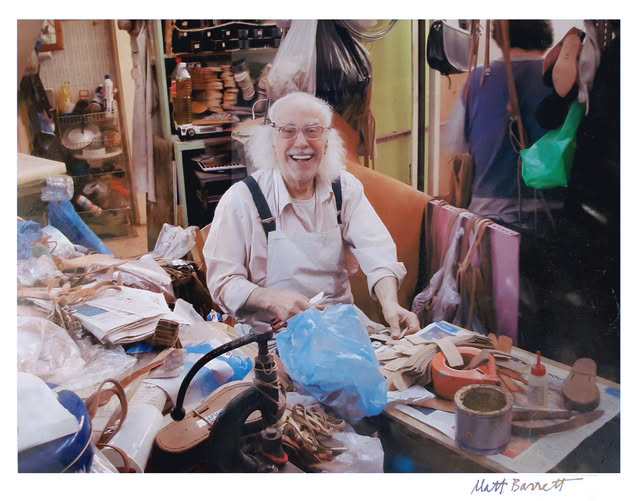
Stavros Melissinos in the new workshop in the mid-2000s, photographed by Matt Barrett. The photograph was gifted to Pantelis Melissinos by the photographer.

Stavros Melissinos was born in 1929 and is well known in Athens and around the world as the poet-sandal-maker of Greece. His books of poetry, plays, and essays have been translated into English, French, German, and Italian, and his best-known work, The Rubaiyat, is on the curriculum of a number of American universities. He has been the subject of documentaries on the BBC and three American networks, and his works are in the Harvard and Oxford libraries. He has also translated the works of many literary greats into Greek. His play Chastity Belt was banned in Greece for political reasons, which made him quite proud.

The shop of the Poet-Sandal Maker of Athens has attracted some of the biggest names in art and culture of the last half century, including The Beatles, Sophia Loren, Rudolf Nureyev, Margot Fonteyn, Jackie Onassis, Anthony Quinn, George Peppard, Ursula Andress, Joseph Cotten, and Gary Cooper, all of whom have worn the sandals of the poet.

When asked by Canadian writer Jason Schoonover why such a renowned poet would continue to work a regular job as a sandal maker, he replied: “A writer who does nothing but write is like the moon, which gives off some light, but borrowed from the sun. A writer needs first-hand experience, which only working in another field can give him. Otherwise he is rewriting what he has read in other books.”

The designs of his sandals, like his poetry, which is influenced by Greek mythology and history, are based on the footwear of the ancient Greeks who once walked the streets of the ancient Agora, in the very place where his tiny shop once stood.

He tells of the first of many visits by The Beatles in 1968: “First of all one of them comes, the intellectual one… Lennon. He told me he had found my works somewhere. Then they all came in, like the seven dwarfs. There were bodyguards too and we had to close the shop because their followers would have wrecked the place. They all bought many pairs. Later my children asked why I did not ask for their autographs. Why did they not ask for mine? I will be around long after The Beatles.”

It seems he was right.

From the 1920s, the small shop at 89 Pandrossou Street had been the workshop of Stavros Melissinos, the Poet-Sandal Maker of Athens. Before Stavros, his father had worked there. Because of the Olympics, Melissinos, an icon of Athens, was evicted by the new landlords, who wanted to get more money out of the space. Olympic greed was a disease that infected the whole city, but this was an especially disturbing act. Melissinos was a national treasure.

But Monastiraki’s loss became Makrianni’s gain. To find Stavros’ shop, now run by his equally talented son Pantelis, a poet, playwright, musician, painter, and philosopher, take the metro, or walk, to Acropolis Station, next to the Acropolis Museum at the intersection of Makrianni Street and Diakou Street. Walk down Diakou and you will see it on your left at the intersection with Tzireon Street. If you have Google Maps handy, it is at 16 Tzireon.

I’m not just Cretan, Spartan, Athenian, Macedonian
All Greek, the whole of Greece in my chest I have enclosed
And whoever the Greeks divide, ’tis my ancestral duty
To strike them back with the lance of Eternal Truth

I’m European; I’m Asian; I’m African
American; Australian; Oceanian, son of the Pole
I’m all the people sheltered under the same sky
A child of Heaven and Earth: Man, the measure of all things

And finally, Christian or Jew, Brahmin or Buddhist
Muslim or you who owe allegiance only to your own meditation
Just think of the ever-pure butterfly of instinct
That flies in time and space in gardens without boundaries

Stavros Melissinos

BUT THERE’S ALWAYS ROOM FOR SHOES!!! RIGHT?

And not just any shoes. Meet Stavros Melissinos, poet, shoemaker, and jewel of a man.
Melissinos has been in business perhaps twice as long as I’ve been alive, and he still comes to his small shop daily, working strips of leather and soles of rubber into wonderful sandals and shoes which age like a fine Margeaux.
Melissinos and I have a shared love for Greek mythology (although I’ll defer to his knowledge any day!). Ancient Greek religion, literature, and history serve as a major influence on his work both as a poet and a shoemaker. Many of his sandal designs are reminiscent of footwear seen on red- and black-figure vases.

I had two pairs made in a light tan leather that’s since darkened into a rich golden brown. The first was a basic strappy pair I knew I could wear with jeans back home in NY. And the other, my favourite, is an Athena-inspired pair featuring long leather cords that wrap around the ankle or calf up to the knee. Both have thin rubber soles, which are shockingly durable.
I had a month-and-a-half and three countries remaining in my trip when I bought the shoes. I wore them constantly for the rest of the summer, walking cities, hiking ruins, and mushing them daily into an overstuffed backpack. Both pairs have not only survived, but are still in excellent condition, and they are more attractive and comfortable today (9 months later) than before. One pair just survived constant soaking in Thai long tail boats!

Stavros Melissinos and his shop were highlights of my Athens stay, and I encourage anyone to visit him. His sandals are inexpensive enough (about $18 per pair last summer) to buy as gifts, and he makes them small enough even for toddlers.

http://www.athensguide.com/poet.html

Stavros Melissinos
The Poet-Sandalmaker of Athens

A poet, a playwright, and a sandalmaker by trade, Stavros Melissinos is known worldwide for excelling in all three fields.

Stavros began writing while in the army. His friends would want to send letters home to their sweethearts in the form of short poems. Stavros would fix their verse; thus the beginning of a writing career. Since then he has written 5 plays and over 15 books of poetry. The Rubaiyat, at 127 stanzas, written in 1959, is, to this day, studied in major universities throughout the world. And he’s quite proud that his play, Chastity Belt, was banned in Greece when it originally was published.

He’s made sandals for Sophia Loren, the Beatles, back in the late 60’s, and many other swells, including me, some 30 years ago.

I first met Stavros in 1969. I had been in the U.S. Navy and Athens was one of the ports of call. In the shadows of the Acropolis there is a shopping area known as the Plaka where artisans and local merchants sell their wares. I stood in front of the cluttered shop and looked at the sign, The Poet-Sandalmaker of Athens. Once inside, I could tell these were no ordinary sandals, even though they were quite reasonable. There was something about them, perhaps, the poet was putting a piece of his soul into each pair he handmade. And the designs were based on historical footwear. Plato and Aristotle surely wore sandals like these.

Stavros sat me down and measured my feet while we engaged in small talk. He then went to his work station and in a half hour I had the most beautiful pair of sandals, sandals which I wore for 30 years. Many times my friends would say, “where did you get those sandals?” And I would proudly say, “Stavros Melissinos, the Poet-Sandalmaker of Athens, made them for me.” Alas, they finally wore out 2 years ago.

I booked a Mediterranean cruise about 6 months ago and one of the ports of call is Athens. And I thought, now, would it, or could it be possible that Stavros is still in business? Or, maybe his son has taken over? No. Times change, people get older, sons become doctors nowadays. Oh well, wishful thinking.

We arrived in Athens and after visiting the Acropolis we headed over to the Plaka. I didn’t even remember where his shop was. There are so many streets that it’s like a maze. We were strolling down Pandrossou Street, and I said to my travel companion, “I feel something. I feel like I’m zeroing in.” And we chuckled. Could the Greek Gods be directing me? I actually did feel something, perhaps deja vu?

Halfway down the next block at number 89 I see it, the sign, “Poet.” And there, lo and behold, is the shop of the Poet-Sandalmaker of Athens. And I’m thinking, could it be possible? It can’t be; they’ll be machine made, the shop run by a relative. Stavros would be 75 by now. I walk in. Absolutely nothing has changed. Customers are milling about. I see an elderly man at the cobbler station and I walk over.

“Stavros?”

“Yes.”

“You made me sandals 32 years ago, and they’ve worn out.”

We chuckled and the other shoppers joined our laughter. After some reminiscing I told him what I wanted, or what I had, and he sat me down and measured my feet.

“Make me two pair, Stavros. I figure they’ll last me 60 years.” My friend also sat for a fitting.

Stavros went to his cobbler station, and we went to lunch. Two hours later we return and pay him $17.00 for each pair. He does a final fitting to make sure they’re just right.

He places the sandals in a bag and instead of a receipt, he gives all of his customers a copy of his latest work, ISIS, and Other Poems.


HOW SMALL! HOW GREAT!

A mixed orchestra in New York, the soloist: Chinese,
Russian composer, all together on the wind’s wings
And I, the listener – a Greek, shed tears in Athens
How Small, how Great your world God really is.

A fellow passenger on the ship asks where did I get the new sandals.

I smile and say, “Stavros Melissinos, the Poet-Sandalmaker of Athens made them for me.”

American magazine feature — Profile of Stavros Melissinos, the Poet Sandalmaker of Athens, exploring his poetry, craftsmanship, and celebrated sandal workshop.
Greek magazine feature — Profile of Stavros and Pantelis Melissinos, presenting the transition from father to son and the handmade sandal tradition.
Athens News, February 9, 2007 — Feature titled “The Poet’s sandals,” discussing Melissinos’s legacy, poetry, and the threatened relocation of his historic shop.
International Almanac, May 5, 1972 — Article titled “Poet-Shoemaker,” referring to Melissinos’s Plaka shop and the Jacqueline Onassis connection.
Newlyweds Stavros and Sophia Melissinos in 1955, carrying the family sandal business forward after the recent death of its founder, Georgios Melissinos.
The Greek American, January 17, 1987 — Profile titled “Melissinos: The Sandalmaker-Poet of Athens,” aimed at Greek-American readers.
STAVROS MELISSINOS HOLDING YOUNG PANTELIS
Stavros Melissinos holding his young son, Pantelis—the future third-generation Poet Sandal Maker of Athens.
Rocky Mountain News, August 22, 1993 — Travel feature “Athens: A Sandalmaker with Sole,” presenting him as the Poet Sandalmaker of Athens.
STAVROS MELISSINOS AT THE OLD SHOP’S DOOR
Stavros Melissinos standing at the entrance of his historic sandal workshop on Pandrossou Street in Plaka, Athens.
Greek newspaper article — Feature on Stavros Melissinos as shoemaker, poet, and theatre writer, with emphasis on his literary work.
STAVROS MELISSINOS PLAYING AN UNUSUAL INSTRUMENT
Stavros Melissinos playing an unusual stringed instrument, reflecting the playful, artistic spirit that shaped both his life and his workshop.
The Boston Sunday Globe, May 6, 1990 — Article titled “Athenian sandalmaker has poetry in his sole,” linking his sandals with poetry and the Acropolis setting.
BENNY HILL
A signed portrait of British comedian Benny Hill, personally dedicated to Stavros Melissinos in appreciation of his book.
Greek magazine feature — “The Lord of Sandals,” a colour profile celebrating Stavros Melissinos, his workshop, famous clients, and family tradition.
MELISSINOS FAMILY AND FRENCH CUSTOMER — 2004
Pantelis, Valerie, Stavros, and Sophia Melissinos in the family’s interim Athens workshop during the 2004 Olympic Games.
Greek newspaper feature — Large illustrated profile titled “The poet of sandals and words,” presenting Melissinos’s craft, poetry, and public image.
PANTELIS MELISSINOS AND FATHER IN AGHIAS THEKLAS
Pantelis and Stavros Melissinos in the Aghias Theklas workshop, where the family business was based for fifteen years.
Spiren, September 1965 — Danish magazine article titled “Sandalmager og poet,” an early European reference to Melissinos as sandal maker and poet.
MELISSINOS OLD STICKERS
Original vintage labels from the Melissinos “The Poet” Greek Sandals workshop at 89 Pandrossou Street, Athens.
Town and Country Lifestyle, June 18, 1980 — American feature on Stavros Melissinos visiting relatives while presenting his sandals and poetic identity.
PANTELIS AND FATHER AT HOME
Pantelis Melissinos with his father, Stavros, sharing a warm moment at home in Athens.
The San Diego Union-Tribune, September 12, 1993 — Article titled “Sandalmaker has heart, sole of a poet,” focusing on his poetry, sandals, and Athens workshop.
“PUT A POET ON YOUR PAW” DRAWING
A humorous vintage cartoon celebrating Stavros Melissinos and the imaginative world of the Poet Sandal Maker of Athens.
The Daily Times, February 3, 2004 — Greek newspaper profile titled “The Shoemaker of the Famous,” highlighting his celebrity clients and artistic personality.
SANDALS FROM THE 1960s
Original Melissinos handmade sandals from the 1960s, featuring a historic design that is no longer in production.
The Stars and Stripes, December 15, 1986 — Feature on Melissinos reflecting on his dual career as sandal maker and poet.
STAVROS MELISSINOS AT THE DOOR
Stavros Melissinos outside his historic workshop at 89 Pandrossou Street in Plaka, Athens.
« of 2 »