STAVROS MELISSINOS
THE POET SANDAL MAKER OF ATHENS

An Autobiographical Note by Stavros Melissinos

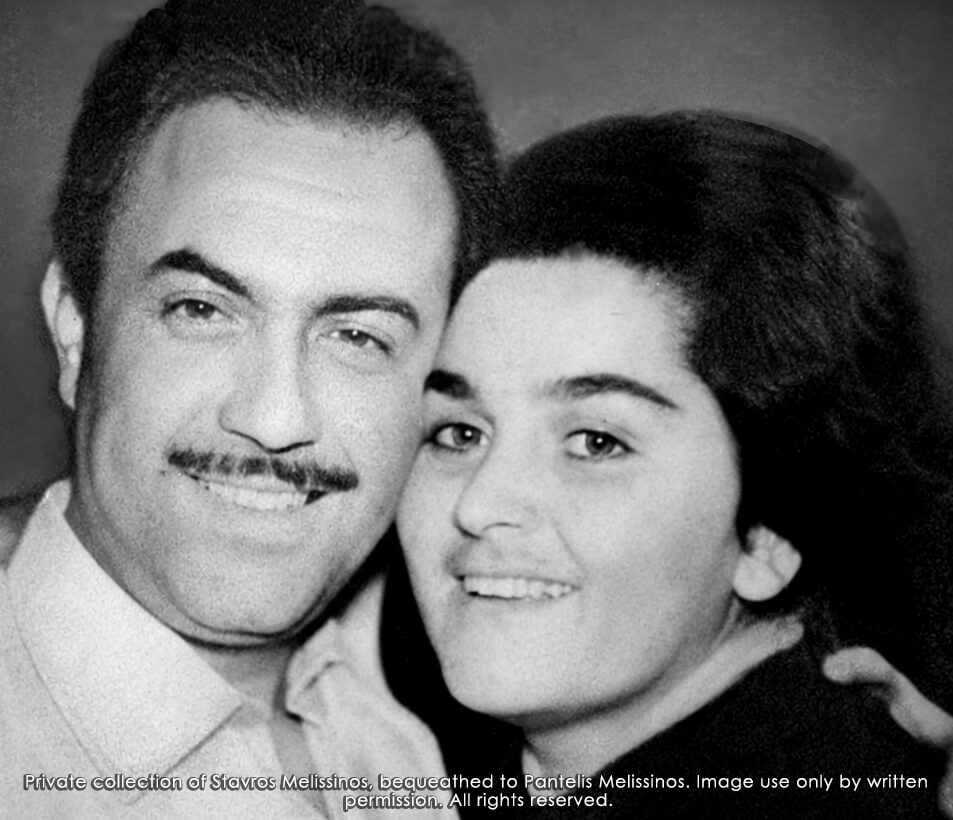
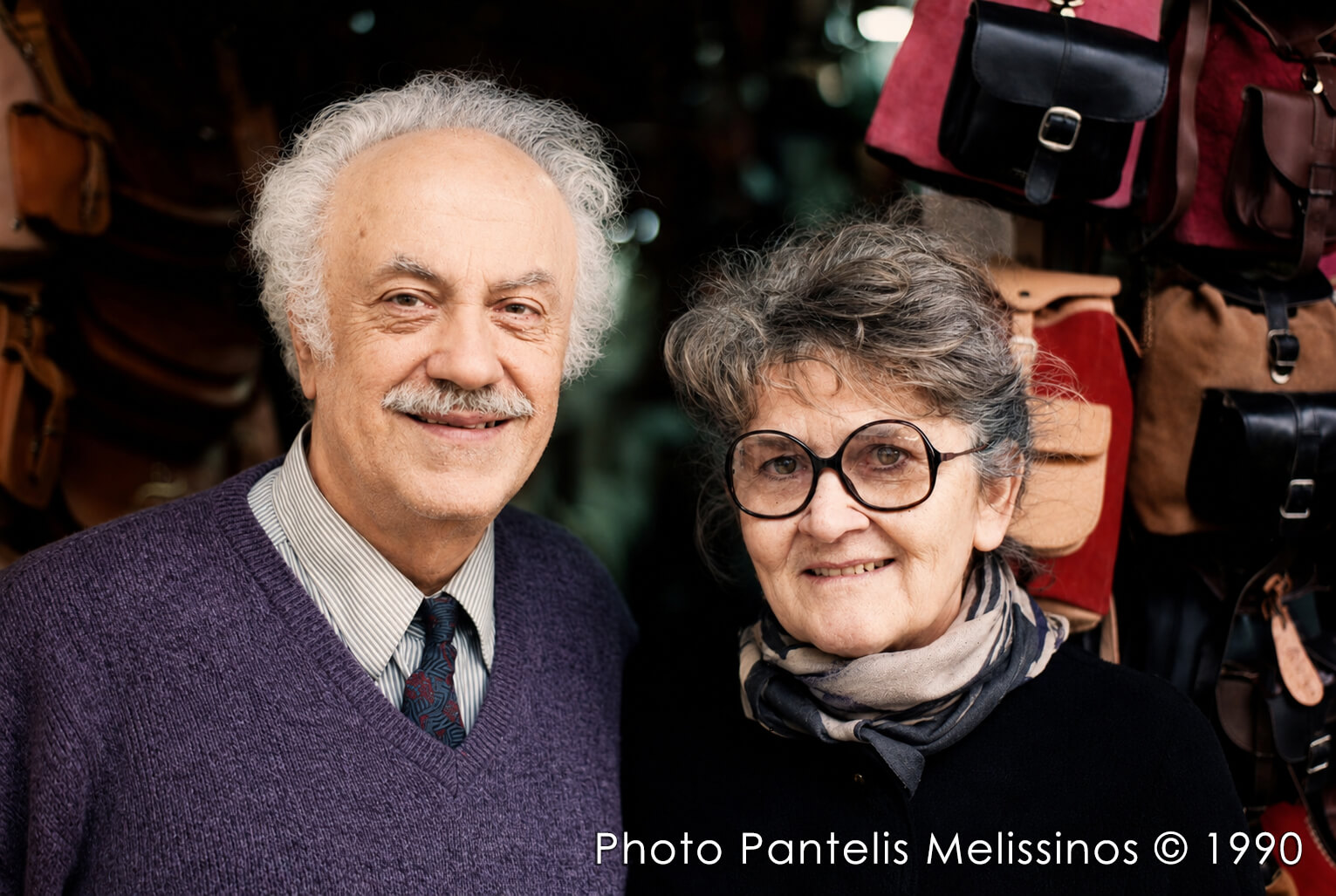
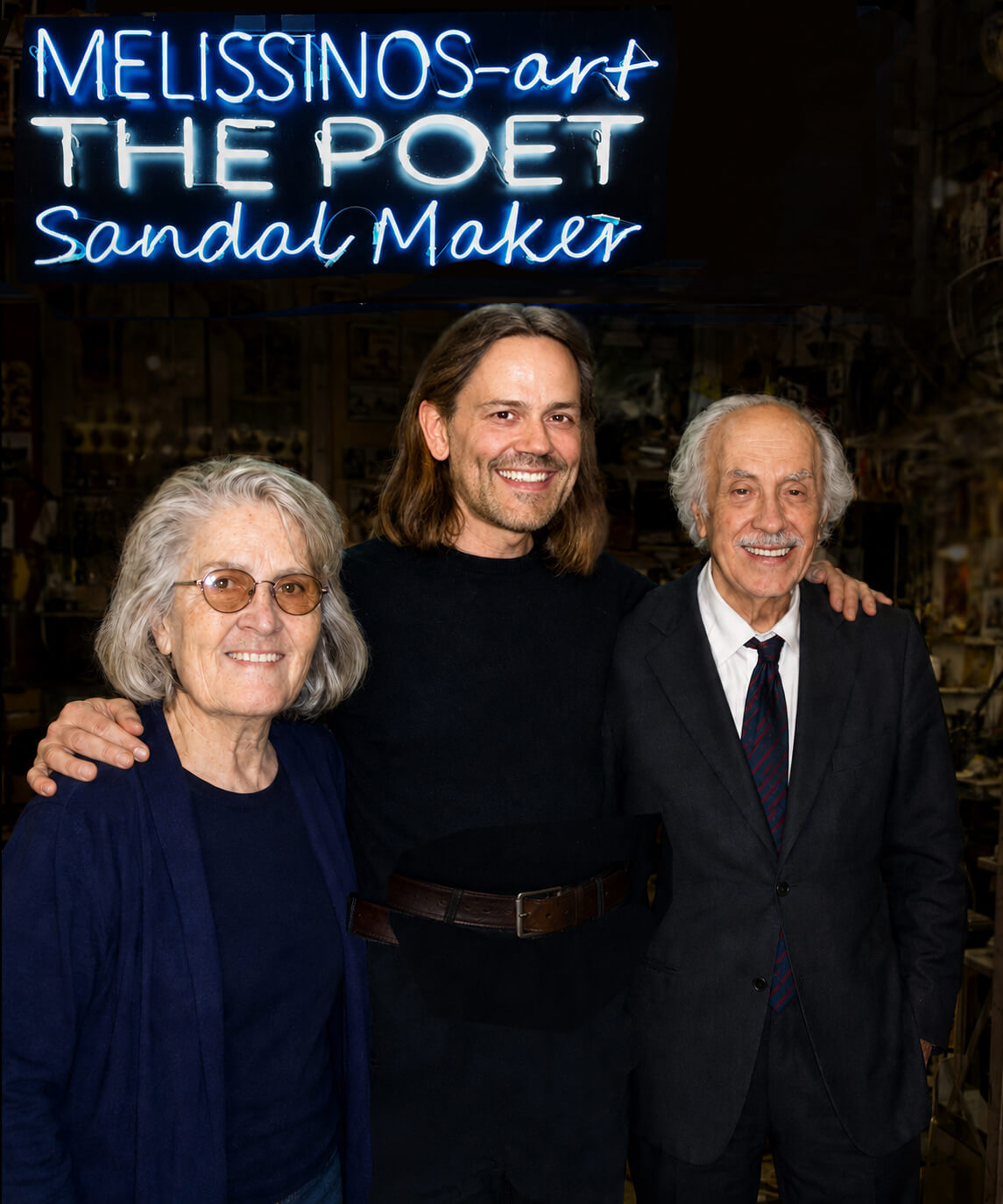
Stavros Melissinos with his wife Sophia

At the request of my son Pantelis, who, as of this moment in 2004 — the year of the Athens Olympic Games — has begun to carry forward my work and legacy, I sit down to reflect upon my life and write this autobiographical note. I do so during what I must admit is an involuntary retirement, with time to look back on the strange road that led me from poetry and cinema to leather, sandals, and the little workshop that became my stage.

I was born in Athens on the 10th of September 1929, in Plaka, the old quarter of Athens, into a family where the smell of leather was as familiar as the sound of poetry. My father, George Melissinos, was a master sandal maker. My uncle Michael, his twin brother, was a poet. Between them — and through the wider family, which carried memories of a heroic past in Crete and the verses of Erotokritos by the Cretan-Venetian poet Vitsentzos Kornaros — they gave me, perhaps without knowing it, my destiny: the hand of the craftsman and the soul of the poet.
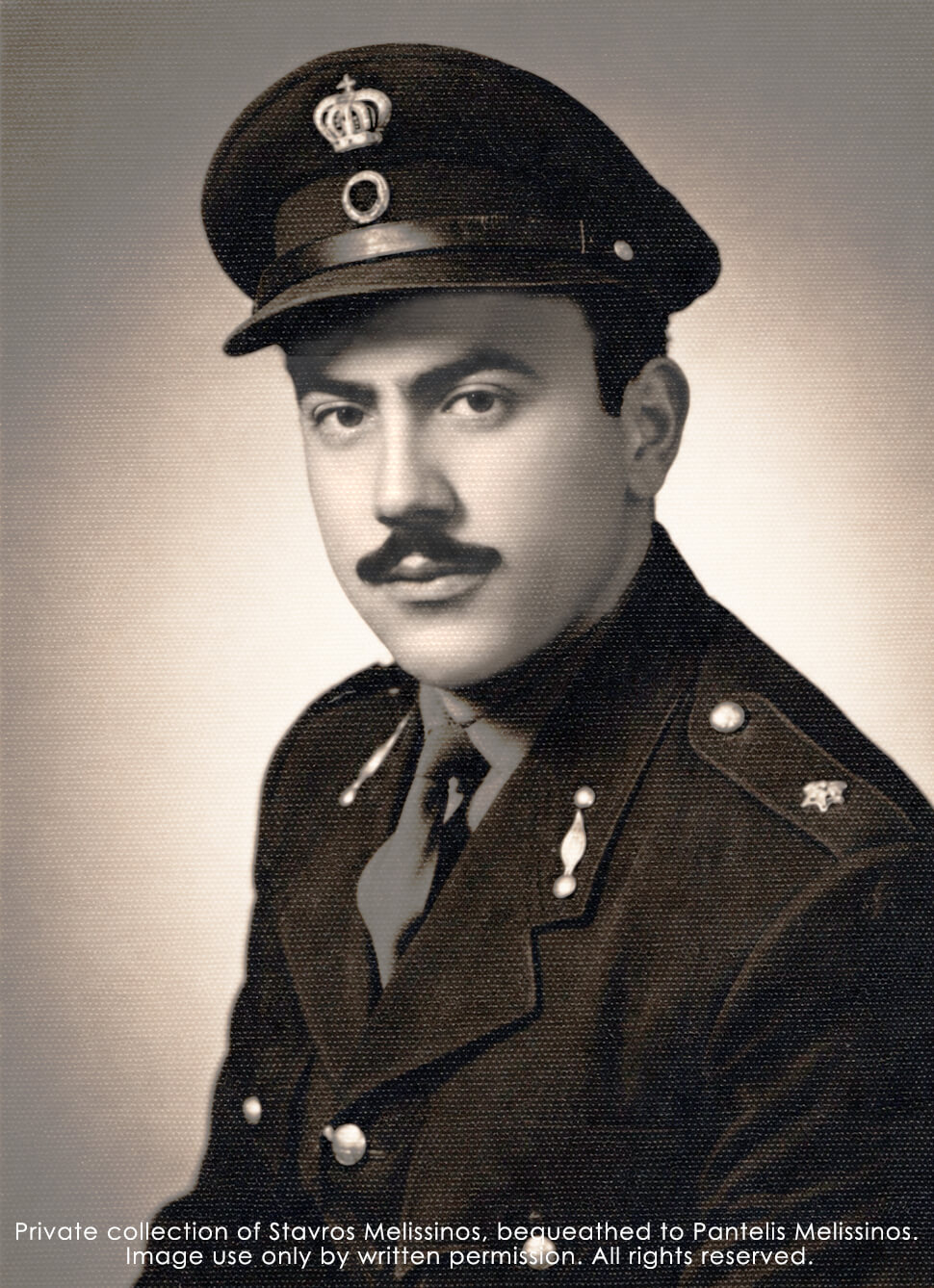
Stavros Melissinos as a young Greek Army officer — a rare portrait from the private archive of the legendary Poet Sandal Maker of Athens and the Melissinos family collection.

At first, I did not wish to become a sandal maker. My mother, who came from the Tselios family, descendants of heroes of the Greek War of Independence of 1821, dreamed of seeing me as a general. This is what I was told, because I never met her. My mother died soon after I was born. But as I grew up, in post-war Greece, watching Hollywood films, I dreamed of the cinema. I wanted images, drama, action, movement, stories, light. But life writes her own scripts, and sometimes she leads us back to the very place from which we tried to escape.

Being an only child, I developed a special bond with my fathera heroic and greatly respected figure in Athenian society. He later married Marianthi Acrithaki, a caring woman who made sure that I would know the long poem Erotokritos by heart. She, too, died early.

After serving in the army, I made plans for a career as a film director, but yet another death changed my course: the death of my father in 1955.

After my father’s passing, and since I was already married to Sophia, my beautiful muse, I entered his workshop with mixed feelings. There, among leather, tools, dust, and memory, I discovered that a small shop in Athens could also be a stage.

I did not want to make ordinary shoes. While trying to understand what my path should be, I continued my old habit: writing poetry. My vague business plans took clearer form when an English choreographer walked through my door and asked for a few pairs of ancient Greek sandals for her dance troupe. At first, busy with my verses, I declined. But my practical and business-minded wife, Sophia, saw it as a sign from the universe and left me no alternative. So I took on the project with great zeal.

I realised then that writing poetry and making something traditionally Greek, something ancient and alive at the same time — something that could offer a small gift to the country I loved so deeply — was perhaps my own path in life.

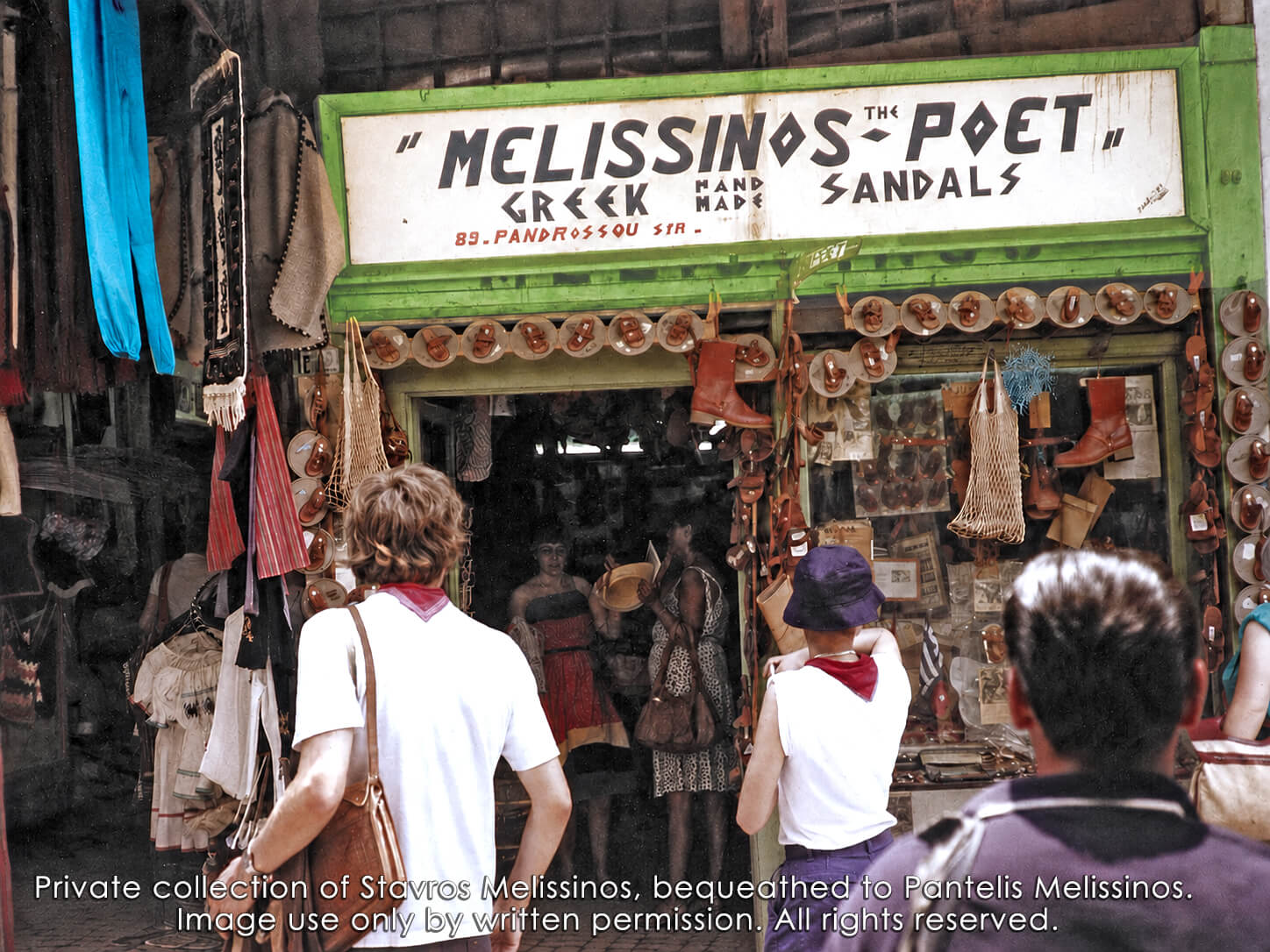
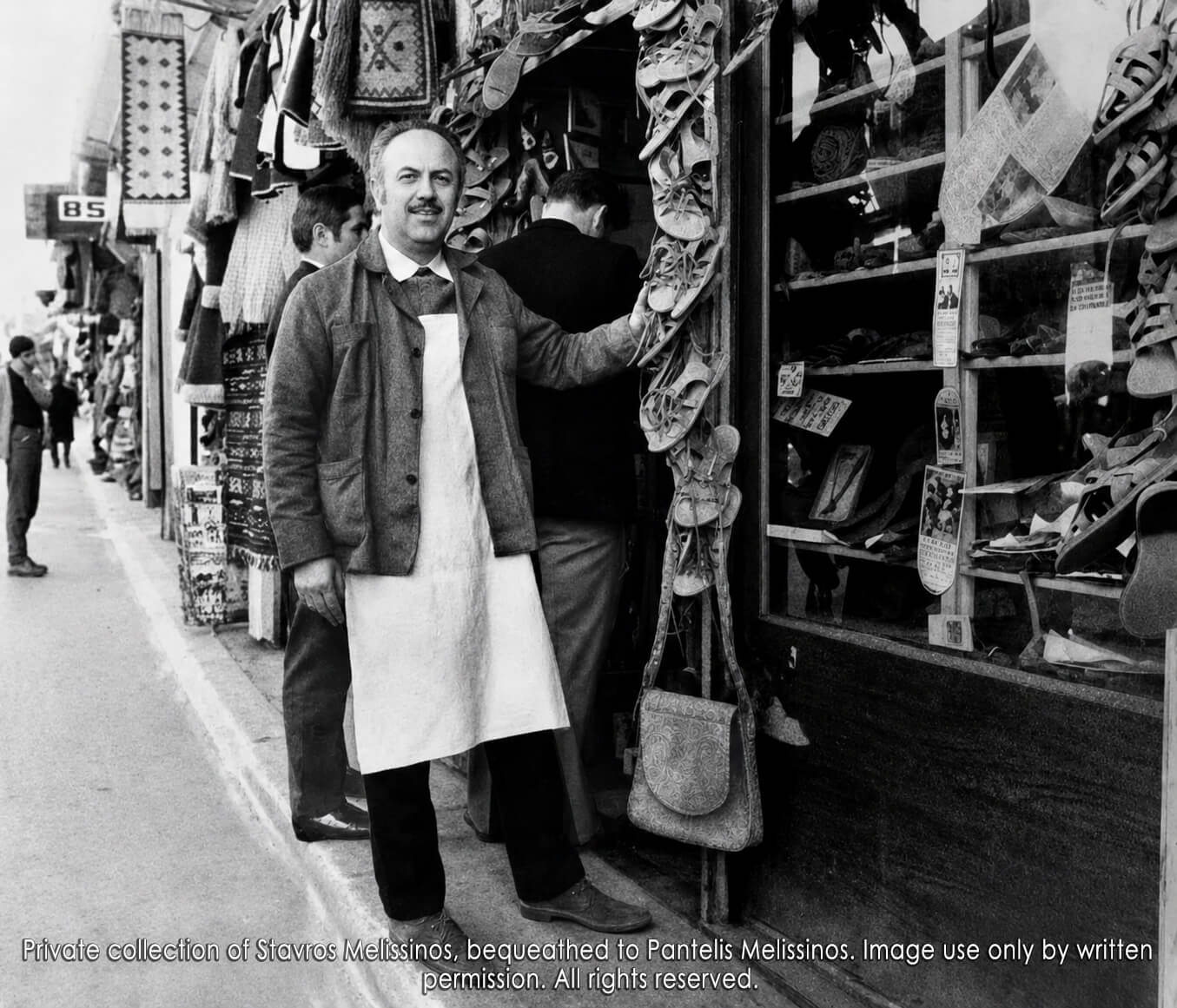
The historic Melissinos “The Poet” Greek sandal workshop at 89 Pandrossou Street in Plaka, Athens — the shop where Stavros Melissinos’s father, Georgios Melissinos, established the family business in 1920.

The ancient sandal was not merely footwear. It was the shape of a civilization. It belonged to history, tradition, theatre, mythology, the road, the body, and the sun. When I began making sandals inspired by ancient Greek forms, I was not copying the past. I was bringing it back to the feet of modern people. Some thought I was crazy, but my great success soon convinced them otherwise.

My philosophy was simple: the sandal must be made by hand, fitted to the person, and born inside the workshop. A foot is not an industrial measurement. It has character. It has memory. It has its own personality and dignity. It cannot simply be encased in a shoe-like prison.

This is why I never wished to turn my work into mass production. Many people wanted me to sell my name, franchise the business, or make the sandals anonymous and profitable in the ordinary way. But I refused. I did not want my name to become a label without a soul. I preferred one real customer standing before me to a thousand pairs made without me — especially when I could recite to them verses of my philosophical poetry and exchange views and ideas with them like true Athenians of the past.

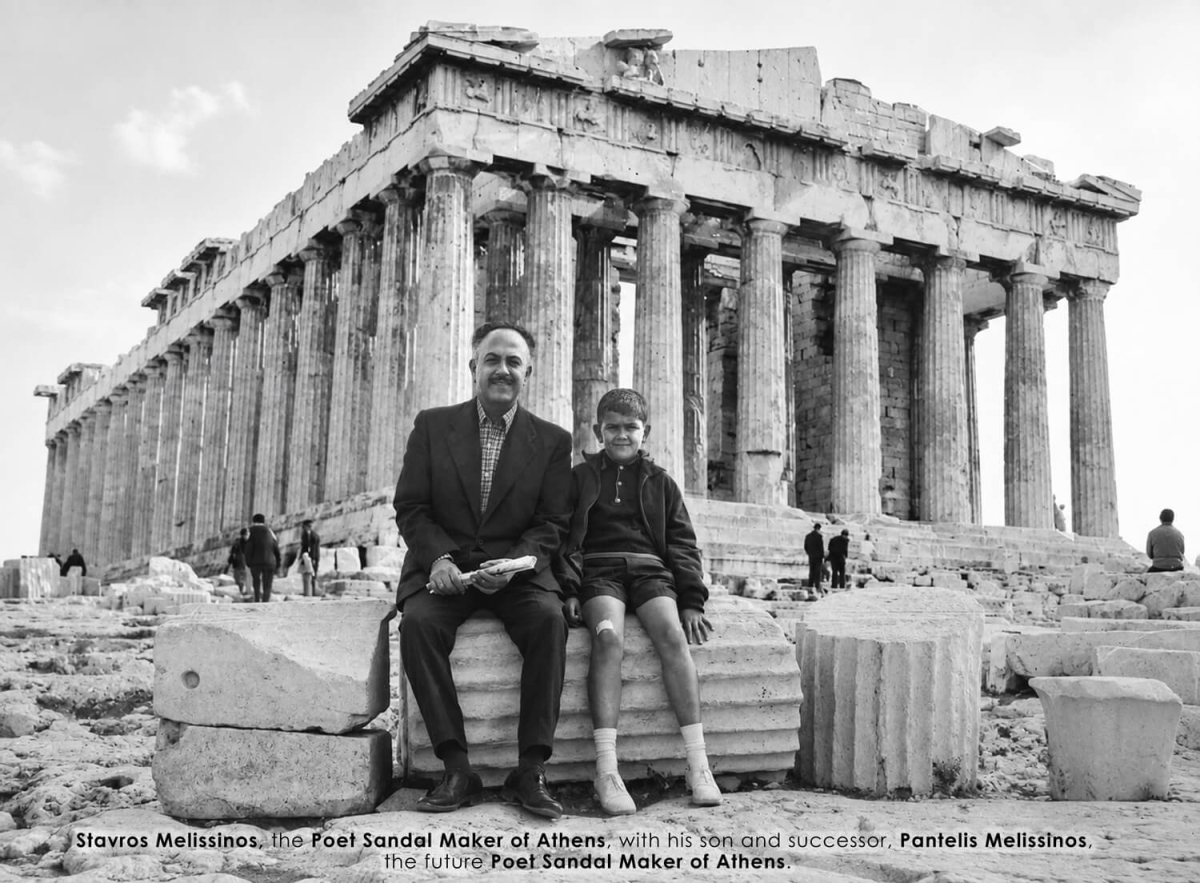
Stavros Melissinos with his son Pantelis on the Acropolis in Athens, during one of their visits to the old Acropolis Museum, where Stavros studied ancient Greek sandal design.

In time, the world began to seek out my little workshop. Artists, poets, actors, dancers, hippies, queens, and people with no title at all came — which was often even better. The famous and the unknown sat on the same old chairs my father had kept in our workshop, waiting for the same thing: a pair of made-to-measure sandals made for them by my hands.

One day The Beatles walked into my workshop. They had come to meet the poet and sandal maker of Athens and to have their sandals made before heading for the Greek islands. They had been told about me, my poetry, and my sandals. They entered with the strange innocence and comic rhythm of a fairy tale, almost like the Seven Dwarfs from the Walt Disney film — forgive the parallel, but that is how they seemed to me in that moment: a small magical procession, cheerful, curious, and completely unexpected. In my shop, even legends had to come on a kind of sandal pilgrimage.

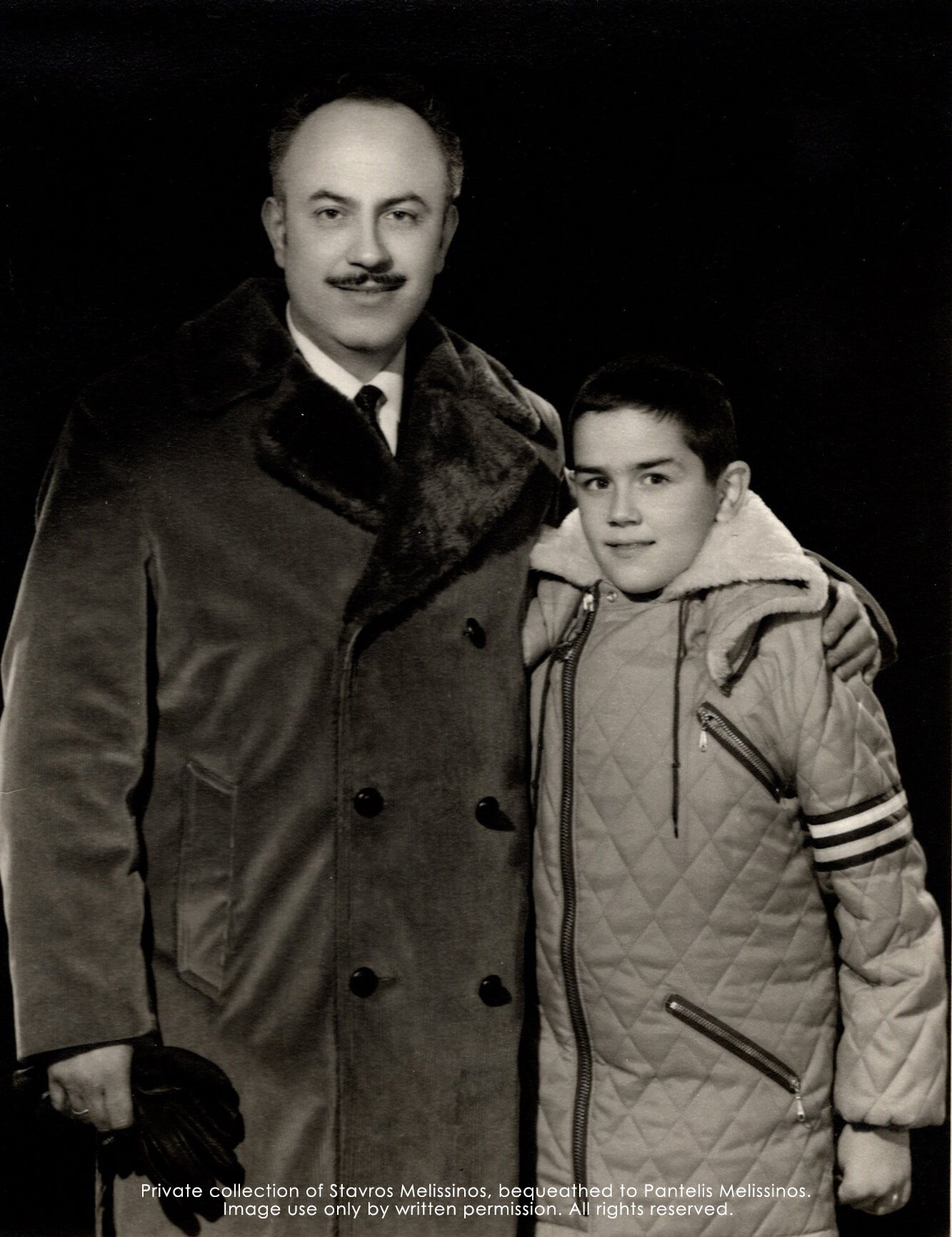
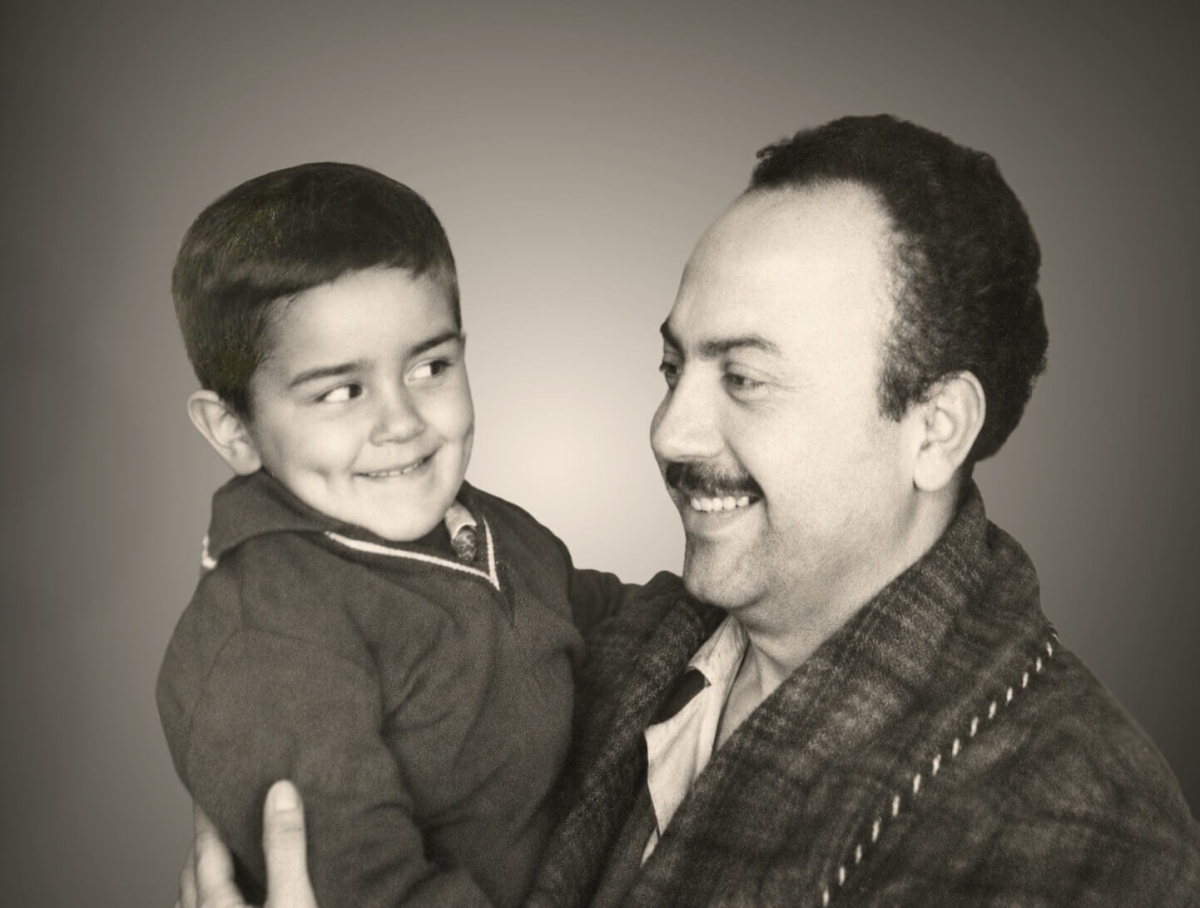
Stavros Melissinos with his young son, Pantelis Melissinos—the poet sandal maker beside the future third generation of the family tradition.

Years later, my son Pantelis asked me why I had not asked for their autographs. I answered him with a little mischief: “My work will still be here when they are long gone.” What I meant was simple. Through my literary work and my craft, I was trying to build something that would outlive the noise of the moment.

My son Pantelis grew up inside this world, which he adored, and he was always by my side through our shared interests. His elementary school was only a block away, near the house where I was born, at 6 Pikilis Street, beside the Ancient Agora of Athens. He knew the workshop not as a business address, but as a living, fairy-tale place where magic was happening. He loved the leather, the tools, the visitors, the theatre of daily work, the chaos, the humour, the fatigue, and the pride.

After school, he would always come to help — although he was occasionally something like Dennis the Menace. He was always under my feet, moving around, hyperactive, like a busy bee. But I allowed him to bond with this dream, just as my father had allowed me to bond with the workshop before him. Between us there was always more than the usual relationship of father and son. There was a silent apprenticeship, made not only of technique but of spirit.

I enjoyed the fact that he understood that the workshop was not only about making sandals. It was about protecting a name, a memory, and a way of standing in the world.

Pantelis followed his own artistic road. He studied in Florence and New York City, earned his degrees from Parsons School of Design, painted, designed sets and costumes for theatre and for the Greek Cultural Center in New York, wrote, and lived abroad. But the thread remained unbroken.

When the time came, he returned not simply to take over a shop, but to continue a family inheritance. What passed to him was not only leather, tools, patterns, or customers. It was the reputation of the Melissinos name, the story of the Poet Sandal Maker, the archive of a life, and the responsibility to carry the tradition forward without betraying it — to continue our saga.
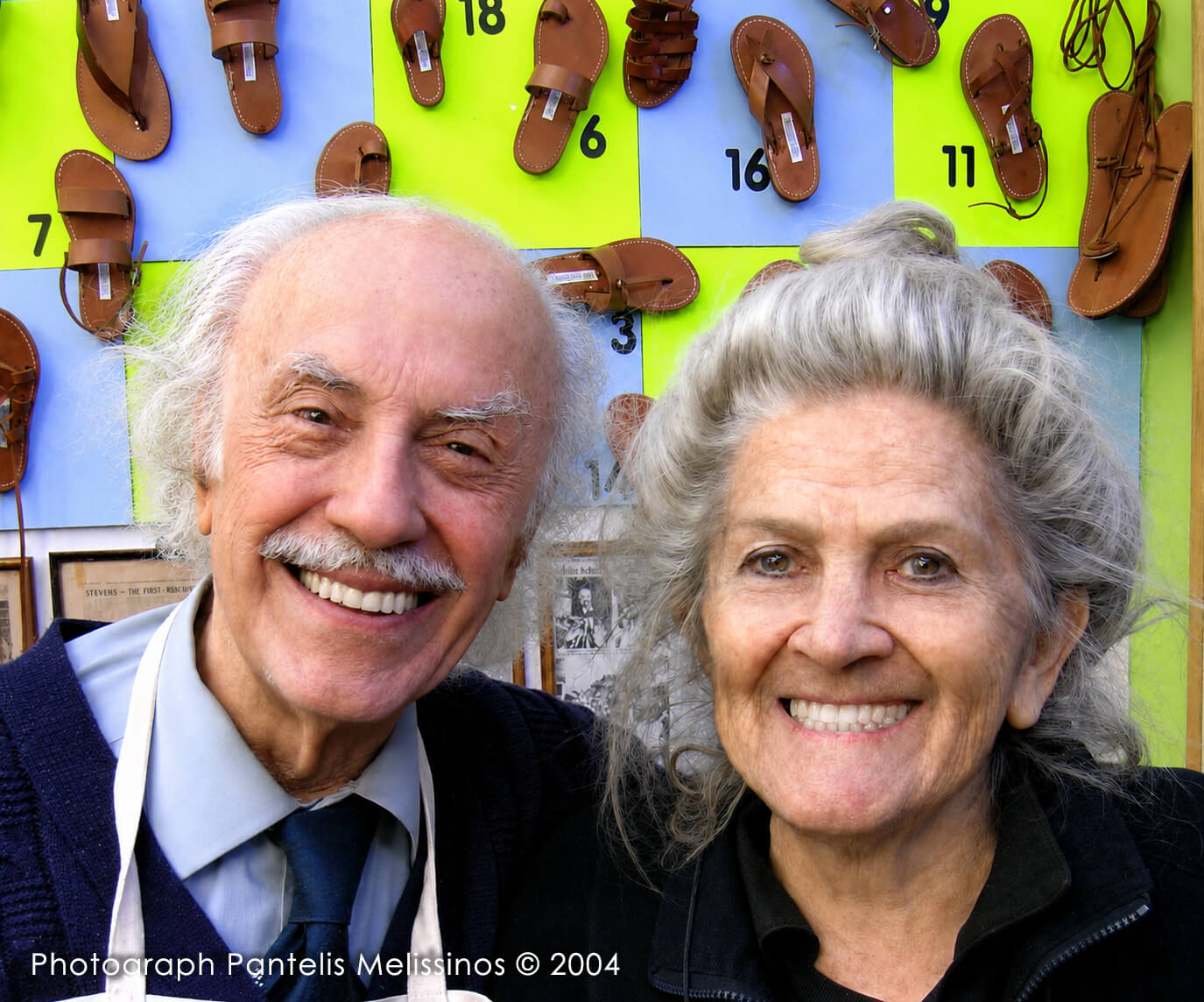
Stavros and Sophia Melissinos in their new Athens workshop during the 2004 Olympic Games, as Sophia was beginning to experience the effects of Alzheimer’s disease. Photograph by Pantelis Melissinos.

He also returned to stand beside us, his ageing parents, as the page of our lives now turns to a difficult chapter, with his mother’s Alzheimer’s slowly clouding her memory.

But let me go back to the remarkable people who crossed my threshold. Each of them appeared there briefly, almost like a guest star on the small Athenian stage that my workshop had become. The Beatles were not the only ones. Joseph Cotten, Gary Cooper, Sophia Loren, Michel Piccoli, Anthony Quinn, Rudolf Nureyev, Barbra Streisand — and many others whose names I no longer remember — all became part of the workshop’s story.

In the late 1960s, Jackie Onassis also came into my life, and into the life of the workshop, in a way I never forgot. During one of her visits to our scenic Plaka neighbourhood, I spoke to her. She received my poetry with kindness and understood that my place was not merely a shop. It was part of the living memory of Athens.
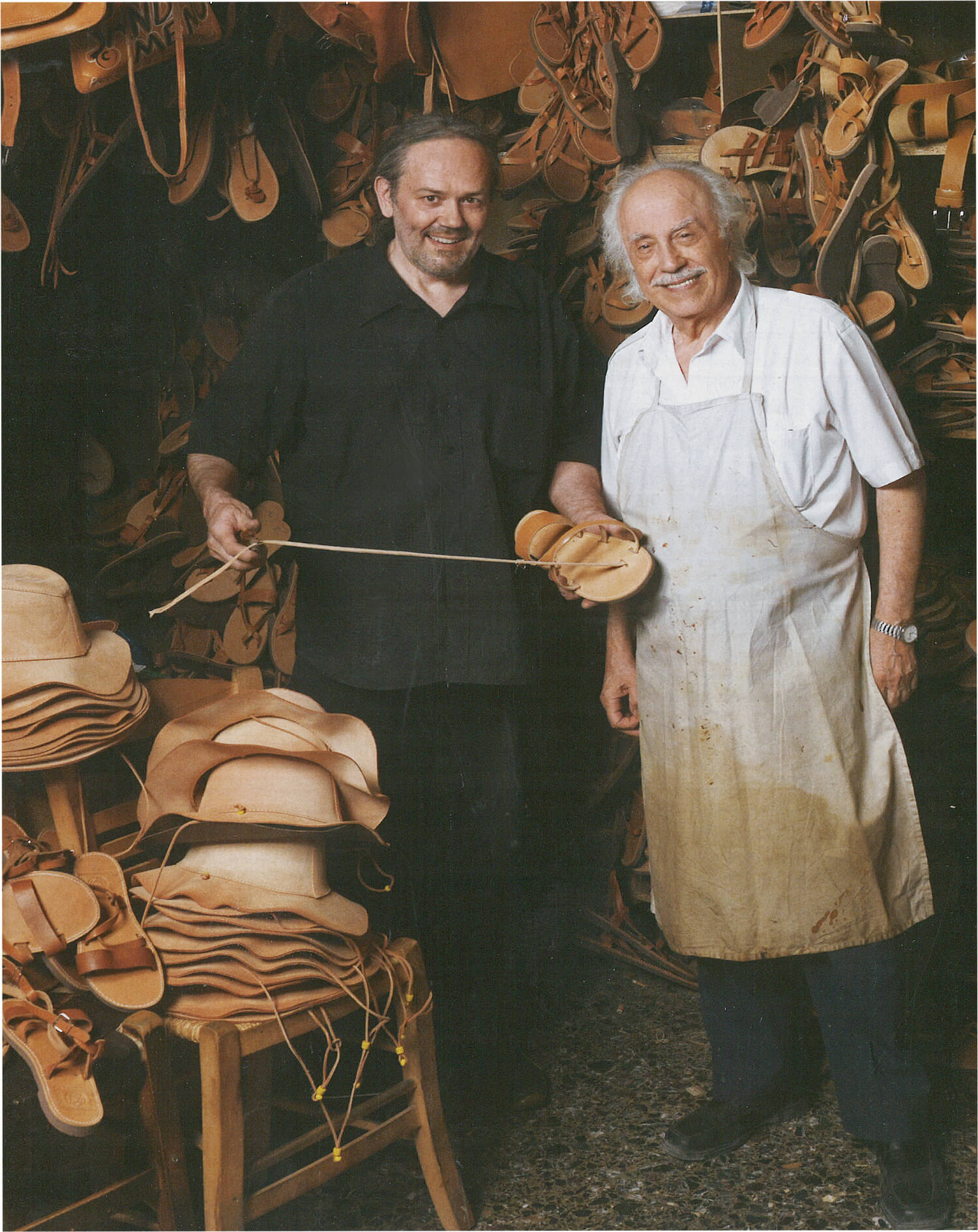
Stavros Melissinos with his son, Pantelis Melissinos, inside the new Melissinos handmade Greek sandal workshop in Athens — continuing the family tradition of leather craftsmanship, poetry, and Greek sandals.

When I told her that the area faced the threat of demolition under government plans, her direct support helped protect not only my workshop but also the neighbouring shops around it in the Monastiraki area. For this I remained deeply grateful, and the shopkeepers of the area almost wanted to erect a statue in my honour. Jackie saw what bureaucrats often fail to see: that a city is not made only of real estate, stones, and streets, but of human history, places, voices, hands, habits, and memories.

I always believed that commerce without culture is poverty, even when it makes money. A shop can be a temple of vulgarity, or it can be a small theatre of civilization. I wanted mine to be the second. I wrote poems between customers. I spoke with visitors. I measured feet. I argued, laughed, observed, and made sandals.

I was not divided between poetry and craft. To me, they were the same act. A poem is made by hand. A sandal, if it is honest, is also a poem.

This is why I never considered my workshop a commercial property in the ordinary sense. It was my own personal podium, a place from which I could express ideas, sometimes disliked by the establishment of the time. It was built from hands, poems, friendships, visitors, photographs, books, conversations, and countless pairs of sandals that left Athens and walked into the world.

If my sandals travelled farther than I did, if my poems found readers in places I never saw, if people remember the little workshop as something more than a shop, then I am satisfied.

I published many books of lyrical poetry, influenced by the romanticism of Omar Khayyam, by philosophy, by Greek history, and by the heroic imagination. My poetry was translated into several languages abroad. My works entered the libraries of Harvard and Oxford, and I was featured by major television networks and media throughout the world. My Rubaiyat, written in 1959, celebrated life in 127 stanzas, with wine as its symbol, and was included in the curriculum of several American universities.

I was called the Poet Sandal Maker of Athens. It was not a title I invented as a marketing trick. It was the truth of my life. The title was given to me by the people and by the journalists who began writing about me. I made sandals as a poet, and I wrote poems as a craftsman. Between the two, I lived.

Stavros Melissinos / Athens 2004
Stavros Melissinos: The Poet Sandal Maker of Athens

A Legend Before the Legend

Long before Stavros Melissinos became the man the world would know as the Poet Sandal Maker of Athens, his name already carried the weight of history.

The Melissenoi Lineage

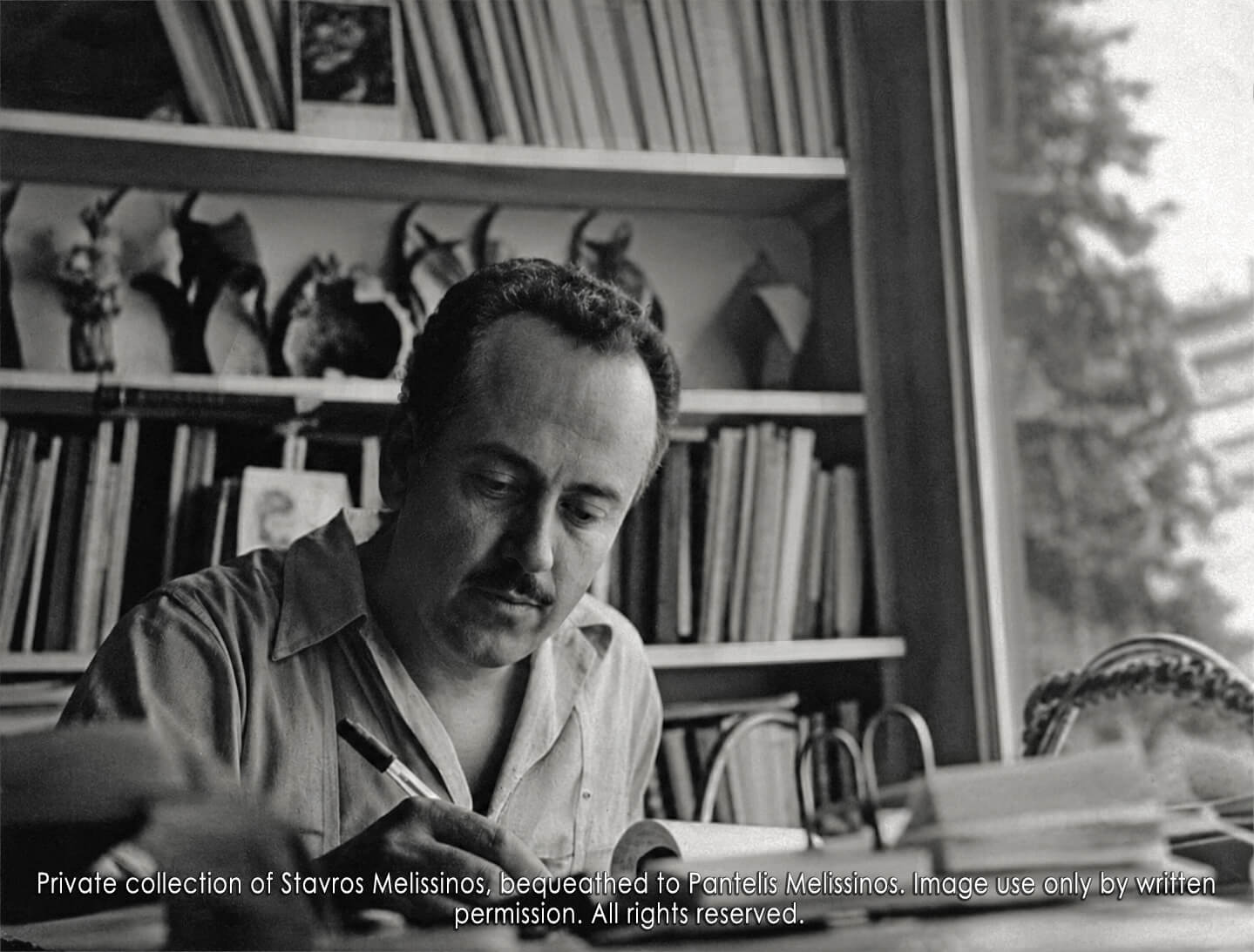
Stavros Melissinos, the Poet Sandal Maker of Athens, writing verses at his desk, surrounded by books and works of art.

Stavros came from the medieval Byzantine house of the Melissenoi, a family whose story stretches from the 8th century to the present day and includes generals, governors, imperial officials, patriarchs, the emperor Nikephoros Melissenos (c. 1045–1104)—albeit a pretender—and some of the Eastern Roman Empire’s most influential figures. Among them was Maria Melissene (c. 1080–after 1136), the famed Duchess of Athens, whose name became part of the city’s medieval history.

His Own Little Empire

Although Stavros Melissinos never walked the shadowed corridors of the Eastern Roman court or marched across imperial battlefields, he was destined to build a legend of his own—in a far smaller empire: his sandal workshop in Athens.
It was there, amid the scent of leather, the rhythm of hand tools, and walls covered with poetry, that he transformed an ancient craft into an enduring symbol of the Greek capital.

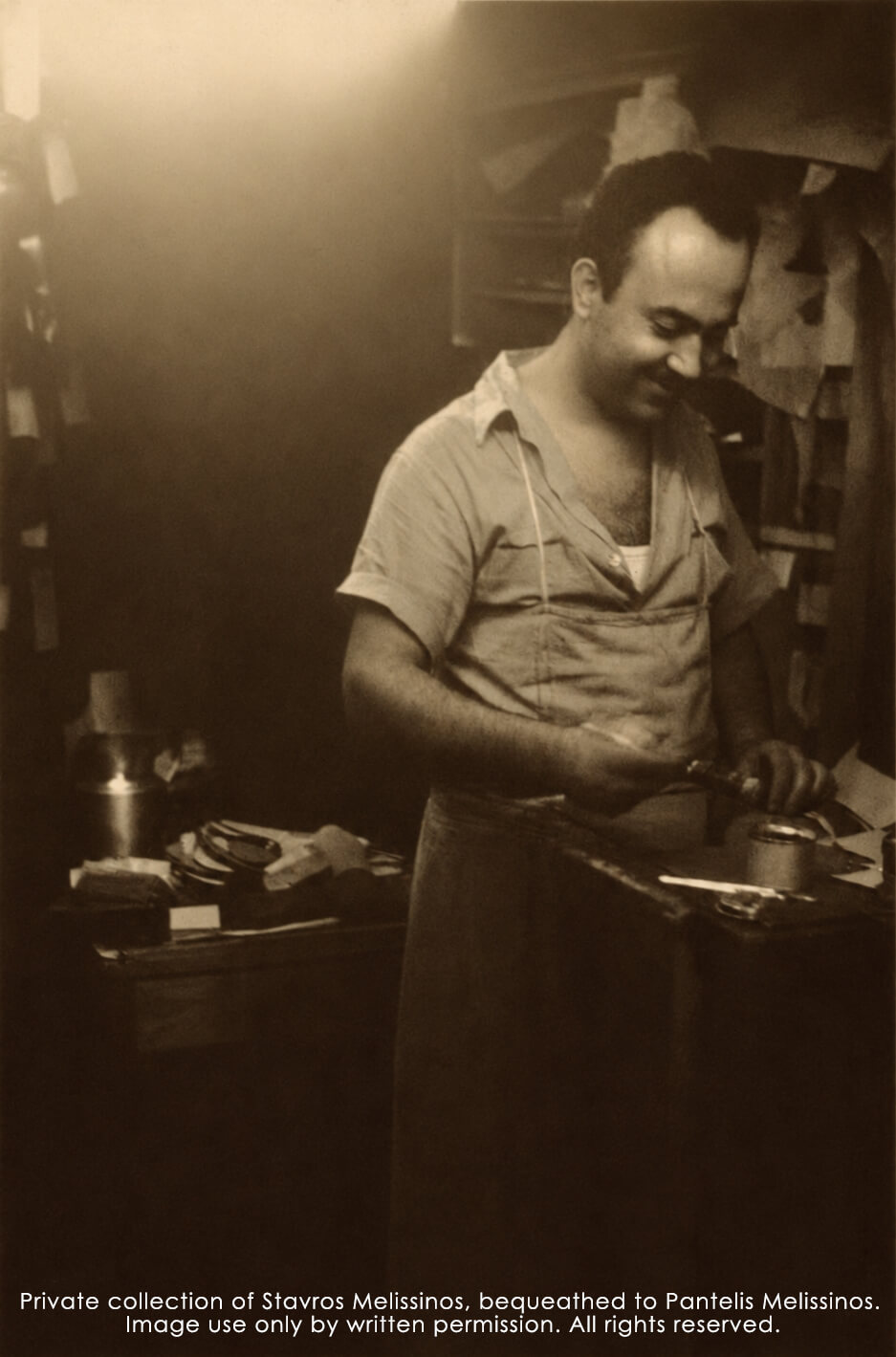
Stavros Melissinos, the legendary Poet Sandal Maker of Athens, working by hand in his historic sandal workshop in Plaka, Athens — preserving the art of handmade Greek sandals and the Melissinos family tradition.

His Weapons

His weapons were leather, poetry, wit, and charm.
From the 1950s through the early 2000s, his modest workshop became a pilgrimage for travellers, artists, writers, musicians, actors, royalty, and celebrities from around the world. They arrived in search of handmade sandals; they departed carrying a story.

From Crete to Athens

The Cretan branch from which Stavros descended left the island in the seventeenth century, after the Ottoman conquest of Crete from the Venetians. Leaving behind estates and fortresses, they passed first to Naxos and Tinos before settling, by the end of the eighteenth century, in Athens — a city ancient, exhausted, wounded, and glorious.

Born in Plaka

Plaka, the old quarter of Athens, where Stavros was born, was more than a birthplace. It was an atmosphere. Its narrow streets, old houses, church bells, ruins, and stones seemed to hold within them the memory of poets, philosophers, merchants, craftsmen, and wanderers. In that setting, the future Poet Sandal Maker first opened his eyes to the world.

A Family of Craft and Commerce

His family history was one of movement, craft, commerce, and distinction. His grandfather, also named Stavros, and his grandmother Zafeiro were chandlers connected with the outfitting of ships — a world of ropes, wood, canvas, metal, and the practical poetry of the sea.

The Shoemaking Workshop

Their son Georgios, Stavros’s father, founded a shoemaking business in Athens in 1920, together with his fraternal twin brother Michael, a poet and writer whose literary promise was interrupted by wartime events in Northern Greece. The family workshop would become the stage on which craft, poetry, and Athenian life met.

MELCO and the Wider Family

Another brother, Panagiotis, founded MELCO (Melissinos Corporation), a company that produced ice refrigerators and household appliances. He was honoured for his achievements in industry and was also a financial supporter of Eleftherios Venizelos. Another brother, Emmanouil, emigrated to America and died there. The family also included three sisters: Theano, Aikaterini, and Vasiliki.

Revolutionary Bloodline

On his mother’s side, Stavros descended from a line of generals, most notably Dimos Tselios-Ferentinos, the celebrated fighter of the Greek Revolution from Missolonghi. Tselios-Ferentinos was a contemporary of Lord Byron, the poet who came to Greece not merely as an admirer, but as a sacrifice, dying for Greek independence on April 19, 1824.

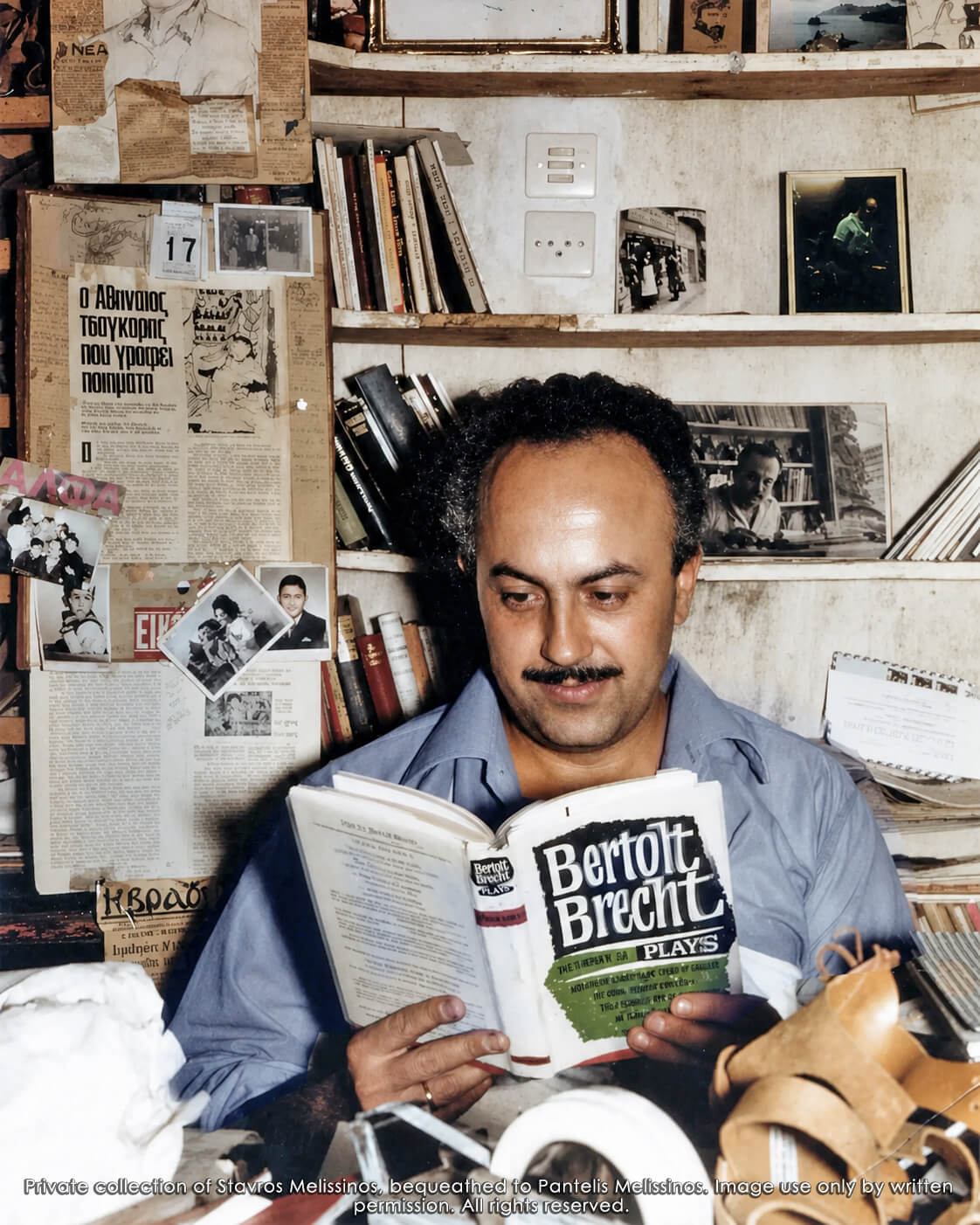
Stavros Melissinos reading Bertolt Brecht inside his historic handmade Greek sandal workshop in Plaka, Athens — surrounded by books, archives, and poetry.

Poetry, War, Craft, and Memory

In Stavros Melissinos, then, poetry and war, craft and exile, trade and memory were joined long before he ever cut a strip of leather or wrote a line of verse.

The Army and the First Poems

After school, in accordance with his mother’s wishes, he served as an officer in the Greek army. It was there, amid the discipline of barracks and military life, that he began writing his first love poems. Their true recipient was Sophia, the woman who would later become his wife, his inspiration, and one of the decisive forces in his life.

Sophia: Wife and Moving Force

Sophia came from a family of international businessmen with commercial ties from Alexandria to Odessa, and from a circle of distinguished figures that included her famous uncle, the fashion designer Jean Dessès. She would become not only his companion, but also the practical intelligence beside the poet.

Cinema, Dreams, and Fate

The army did not suit Stavros’s aspirations. He left military life behind and studied cinema and television at the Stavrakos School in Athens. What attracted him was the world of images, movement, Hollywood mythology, and the magic of the screen. But fate, often the most inventive of directors, changed the script. In 1954, his father died suddenly, and Stavros took over the family business.

The Life Not Chosen

It was not the life he had imagined. Yet sometimes the life not chosen is the one that reveals the man.

Postwar Greece

Postwar Greece was poor, bruised, politically restless, and economically uncertain. Poetry was beautiful, but it did not feed a household. Stavros continued to write, but the family business now required his hands, his attention, and his discipline.

Stavros and Sophia Melissinos in their old Athens shop, photographed by Pantelis Melissinos, 1990.

The Turning Point

Then came the moment that would alter the course of his life. A British choreographer entered the shop and asked him to make several pairs of sandals inspired by ancient Greece, similar to those his father had once produced for the National Theatre of Greece.

Sophia’s Practical Wisdom

At first, Stavros refused. He was occupied with his verses and reluctant to be drawn away from poetry. Sophia, however, understood both the poet and the practical realities around him. With clear intelligence, she urged him to accept.

Six Pairs of Sandals

He did. Stavros made six pairs for the choreographer and placed a few more in the shop window. A door had opened.

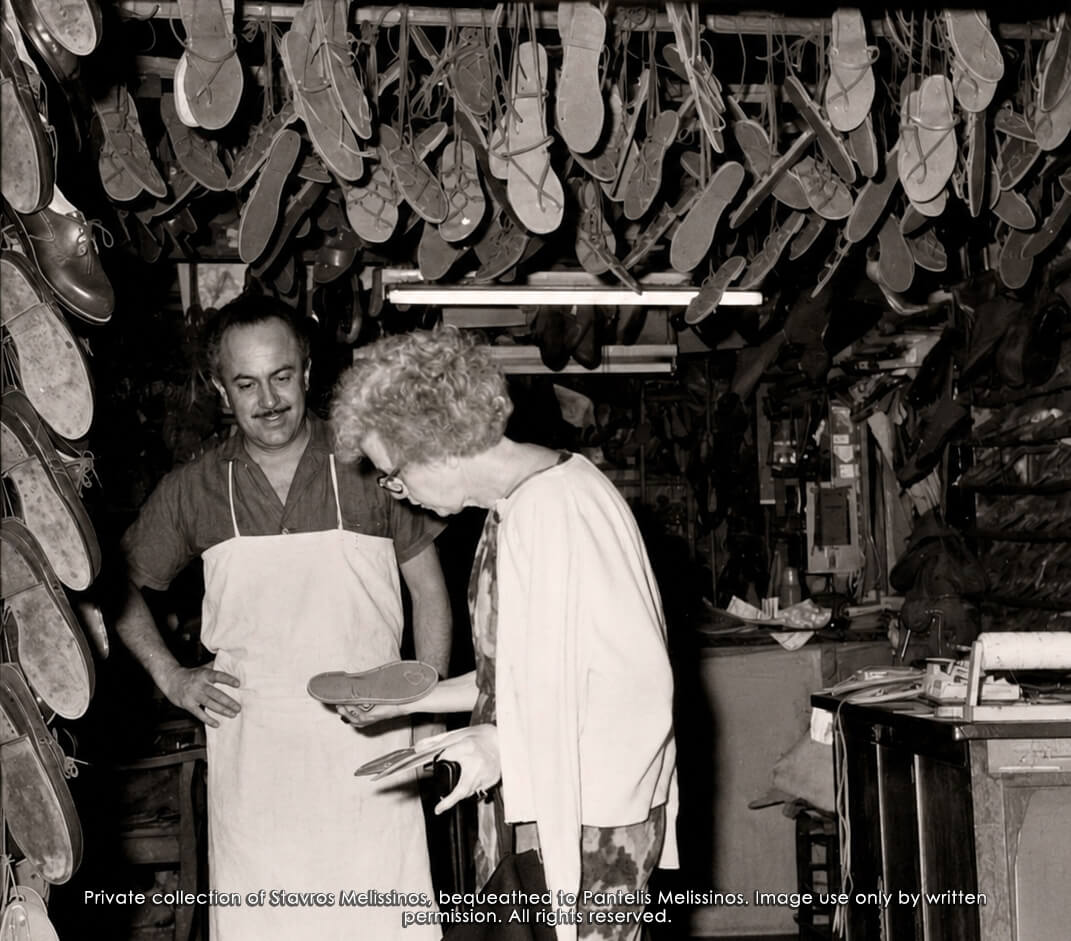
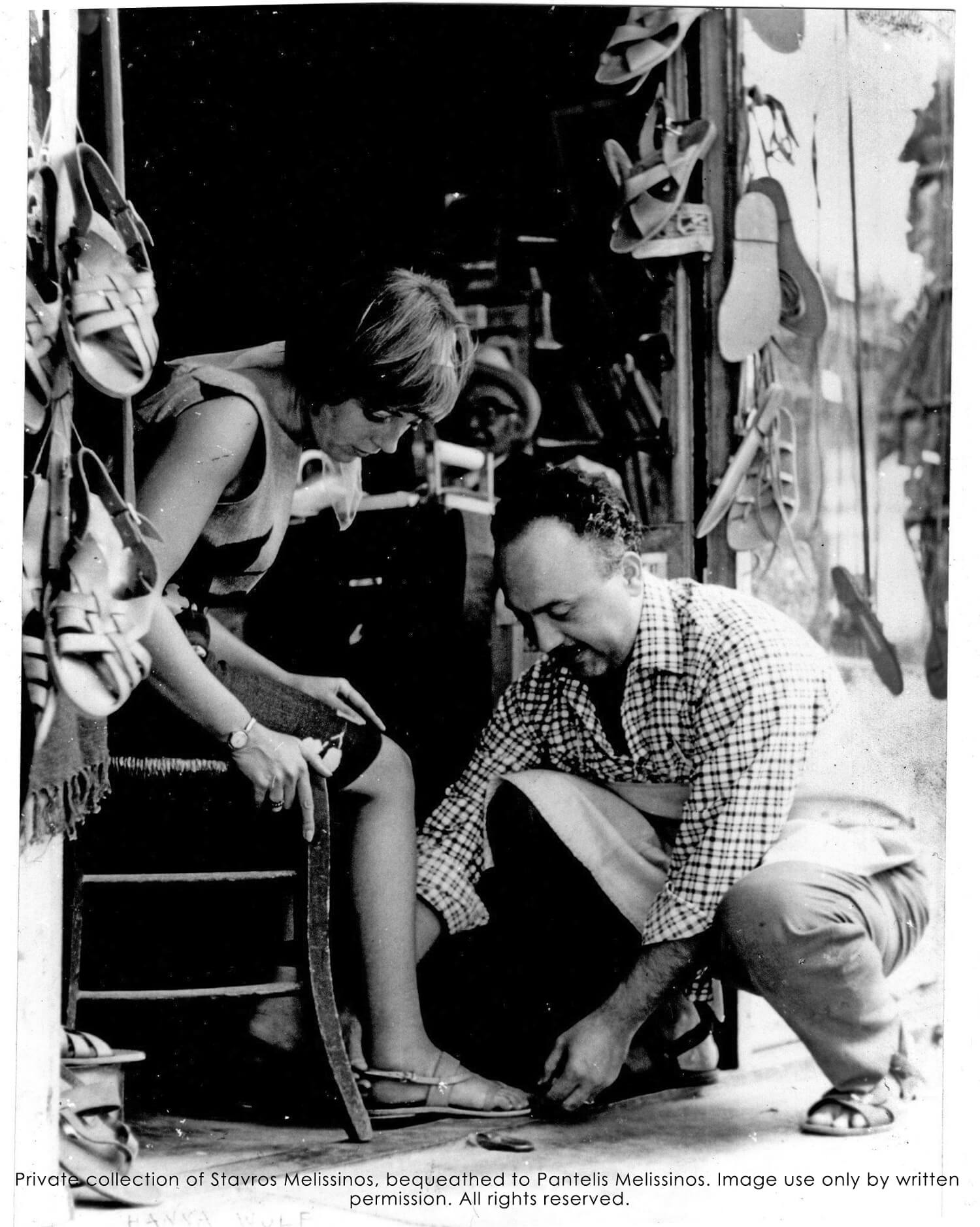
Stavros Melissinos selling handmade Greek sandals to a customer inside his historic sandal workshop in Plaka, Athens — surrounded by the timeless craft and tradition of Melissinos sandals.

The Tourists Discover Him

The first postwar American tourists noticed them, especially young women and the wives of American servicemen stationed in Greece. They admired the sandals, bought them, wore them, and spread the word. Before long, instead of Stavros going to Hollywood, Hollywood came to him.

The Celebrity Workshop

His small Athenian workshop began attracting figures from the worlds of cinema, music, dance, literature, and the international jet set. Sophia Loren, Maria Callas, The Beatles, Jackie Onassis, Rudolf Nureyev, Margot Fonteyn, Anthony Quinn, George Peppard, Ursula Andress, Joseph Cotten, Gary Cooper, and many others passed through the shop.

Bright Birds Passing Through

Their names moved through the place like bright birds, leaving behind photographs, stories, laughter, and the faint scent of another world.

Stavros Melissinos fitting a tourist

The Revival of the Ancient Greek Sandal

Through his hands, the ancient Greek sandal — which might otherwise have remained a museum memory or a theatrical accessory — entered modern life again. It became summer. It became Athens. It became the footstep of freedom. It was humble and aristocratic at once, democratic and divine. It could belong to a student, a dancer, a film star, a queen, a traveller, or a poet. It was made of leather, but it carried myth.

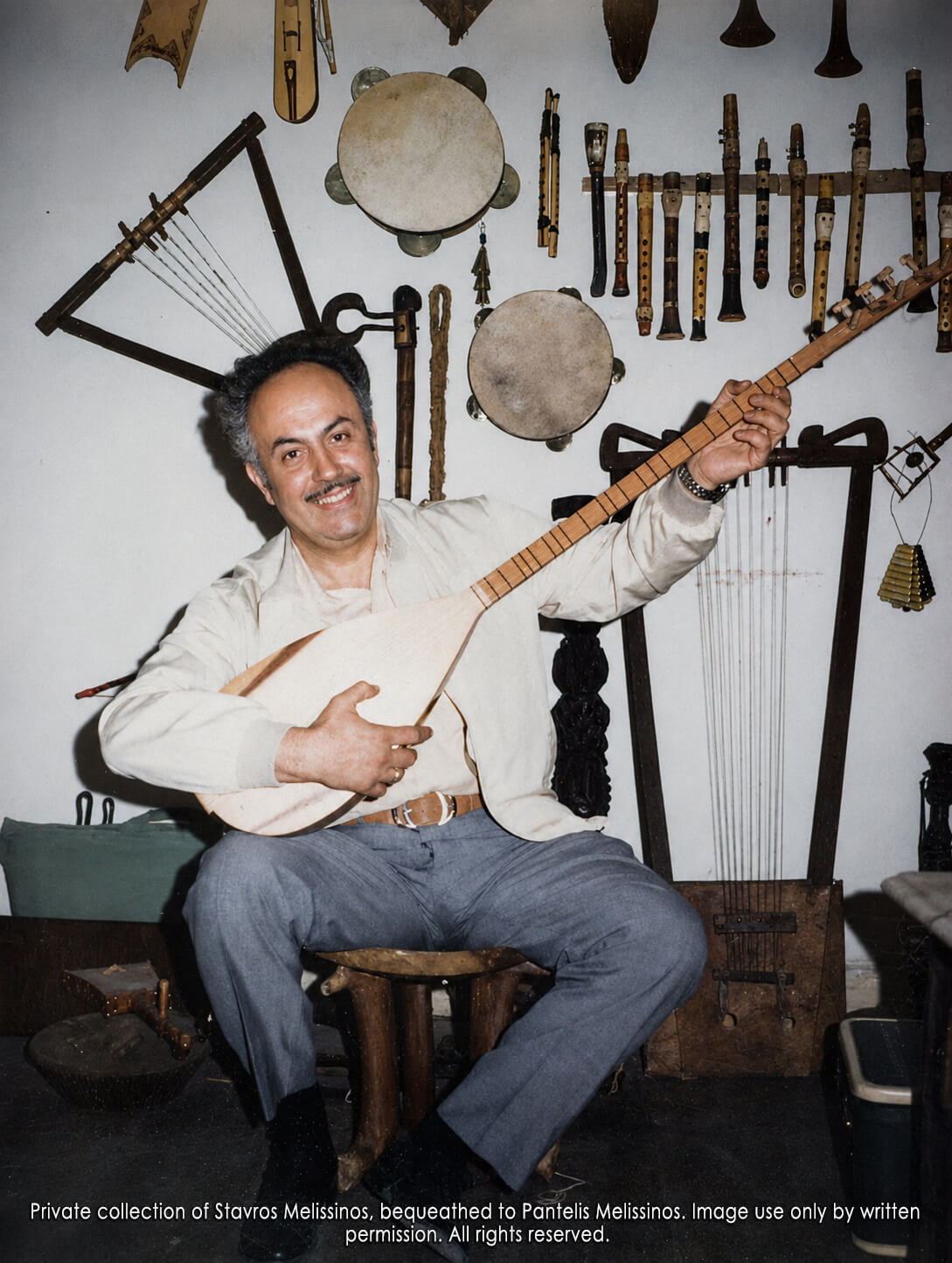
Stavros Melissinos, the Poet Sandal Maker of Athens, playfully pretends to play one of the many musical instruments during a visit to the workshop of a hippie friend.

Against Online Sales and Mass Production

For Stavros Melissinos, the sandal was never a soulless product of mass production. Although American businessmen once promised to make him a multimillionaire if he sold his name and franchised the business, he refused to turn his craft into an anonymous commercial formula. His ideal was person-to-person contact, quality, proportion, and artistic construction — the kind that exists only in the truly handmade and made-to-measure sandal.
Each pair had to answer to a real foot, a real body, a real person. Sandal making was not merely a business transaction; it was an experience for the buyer, fitted, shaped, adjusted, and completed through the direct encounter between craftsman and wearer. His work stood against the impersonal logic of the ready-made and mass production. It belonged instead to an older and nobler tradition, where craft was not industry, but civilization.

The Poet Sandal Maker

And so Stavros Melissinos became known internationally as the Poet Sandal Maker of Athens.

In the Shadow of the Acropolis

His shop stood in the shadow of the Acropolis, surrounded by the restless life of the old market: carts, stalls, brass trays, souvenirs, postcards, statues of Athena, bargaining voices, dust, and movement. Around him was commerce. Within him was civilization.

Stavros Melissinos fitting a tourist

The Living Workshop

The workshop itself was small, unpretentious, and constantly alive. Foreign visitors, local customers, artists, intellectuals, and habitual passers-by filled the space. Some came for sandals. Others came for conversation.

Leather, Glue, and Conversation

The air held the smell of leather and glue, the rhythm of tools, the pressure of fitting, and the quiet transformation of hide into form. In that modest setting, a man of international reputation continued to practise a daily craft with sweetness, discipline, and precision.

A Small Myth in the City of Myths

A Canadian article from 1978 called him “a small myth in the city of myths.” The phrase was exact. Stavros did not resemble the monumental kind of myth, cast in bronze and placed in public squares.

A Human Kind of Myth

He was something warmer and more human: a living myth seated among leather straps and poems, laughing quietly, fitting sandals to foreign feet while speaking about literature, philosophy, theatre, mathematics, and wine.

The Poet Behind the Craftsman

Poetry remained central to his life. He had begun writing in 1953, and by the time journalists came to interview him, he had published ten collections, many of which had been translated abroad. His works were held in the libraries of Harvard and Oxford.

International Recognition

He had appeared on the BBC, on the three major American television networks, on CTV, and in other international media. He wrote plays, translated major literary works into Greek, and held a deep belief in the expressive richness of the Greek language.

The Athenian Rubaiyat

His best-known work, his Persian Rubaiyat, later renamed The Athenian Rubaiyat, was first published in 1959. Inspired by the spirit of Omar Khayyam, it was nevertheless entirely his own: Athenian in wine, Greek in thought, and personal in music.

Wine, Mortality, and Philosophy

Its 127 quatrains celebrated wine, but beneath the wine lay mortality, longing, philosophy, sorrow, and the strange nobility of ordinary life.

A Quatrain by Stavros Melissinos

In one quatrain, translated into English by his son Pantelis Melissinos, he wrote:

The earthly crowns and futile splendours, take away.
I need no granite forts, just let me have while I may
The smile of pain, the tear of bliss and I will build
A “myriad palaces” in me as I live from day to day.

Poetry from Within Life

His poetry was lyrical, romantic, simple, and philosophical. Yet Stavros never separated poetry from life. He saw no shame in labour. On the contrary, he believed that a writer who does nothing but write is like the moon, shining only with borrowed light from the sun.

First-Hand Knowledge

A writer, he argued, needed first-hand knowledge of life, and such knowledge could come only from working in another field. Otherwise, one merely repeated what had already been read in the books of others.

His Secret

Stavros Melissinos outside his old historic sandal workshop at 89 Pandrossou Street in Plaka, Athens.

This was his secret. He did not write above life. He wrote from within it.

The Beatles Anecdote

His humour was as memorable as his philosophy. Years later, when his son Pantelis asked why he had never asked The Beatles for their autographs, Stavros replied that they should have asked for his, because he would exist long after The Beatles.

The Laugh

And then he laughed.
He always laughed.
It was his trademark—a warm, infectious laugh that dissolved the distance between strangers. Customers came looking for sandals, but many remembered the laugh long after they had forgotten the price of the sandals.

Pantelis in the Workshop

Pantelis, his son, grew up just a block away from the workshop. After school, he would wander in, offering what he later jokingly described as “unwanted assistance”—at times resembling Dennis the Menace more than an apprentice.
Yet those afternoons quietly shaped his life. He grew up surrounded by leather, poetry, painting, conversation, and an endless procession of fascinating visitors from every corner of the world. Summers were spent happily working in the shop, measuring feet, watching his father at work, and meeting artists, writers, actors, musicians, politicians, and travellers who passed through its doors.
A gifted artist from childhood, Pantelis illustrated his father’s poetry and later translated many of his poems before leaving for Parsons School of Design in Manhattan to study fine art.

The Third Generation

After returning from New York, Pantelis became the third-generation sandal maker, while establishing himself as an artist, poet, playwright, painter, and theatre designer in his own right.
Continuing the family workshop, he would eventually become known internationally as “The Poet Sandal Maker to the Stars,” a title bestowed upon him by a British television presenter and one that reflected both inheritance and individuality.
Inheritance as Art
Pantelis was born the very year Stavros wrote his Rubaiyat.
The inheritance he received was never merely commercial. It was artistic.
What had begun as shoemaking had become poetry under Stavros. Under Pantelis, it expanded again—into painting, sculpture, literature, theatre, and design—while remaining rooted in the same workshop.

Father and Son

The workshop became more than a place where sandals were made.
It became a studio, a gallery, a library, and a living archive of memory.
Father and son were never repetitions of one another. They were two movements of the same composition: Stavros, who transformed the handmade sandal into an Athenian legend, and Pantelis, who carried that legend into the wider world of art.

The Larger Story

The story begins with the Melissenoi of the Byzantine Empire and continues through medieval Crete, old Athens, and modern Greece.
It passes from ship outfitting to shoemaking, from the MELCO refrigerators of the 1930s to handcrafted ancient Greek sandals, from the National Theatre of Greece to Sophia Loren, from army barracks to the Athenian Rubaiyat, from The Beatles to Bob Saget, and from leather to literature.
In the end, the story of Stavros Melissinos is not simply the story of a man who made sandals.
It is the story of how craft became culture, poetry became heritage, and one small workshop became part of the mythology of Athens itself.

Athens Beyond Marble

For Athens is not only marble, ruins, gods, philosophers, and museums. It is also a small workshop in the market, a laughing craftsman, a woman named Sophia reminding her husband that poetry must eat, a strip of leather on a wooden bench, a famous musician waiting his turn, a child watching his father work, a poem hidden behind a sandal, and a pair of feet suddenly feeling, for one summer at least, as if they belonged to Apollo.

A True Icon of Athens

And so, from a family that had once helped shape the history of the Eastern Roman Empire, Stavros Melissinos created a different kind of legend—not medieval, not imperial, but unmistakably Athenian. His kingdom was measured not in conquered lands, but in footsteps; his legacy not in crowns or titles, but in poetry, craftsmanship, and the timeless spirit of Athens.
That was Stavros Melissinos: craftsman of the earth, poet of the hand, small myth in the city of myths, and true icon of Athens.